
What the Breath Actually Does
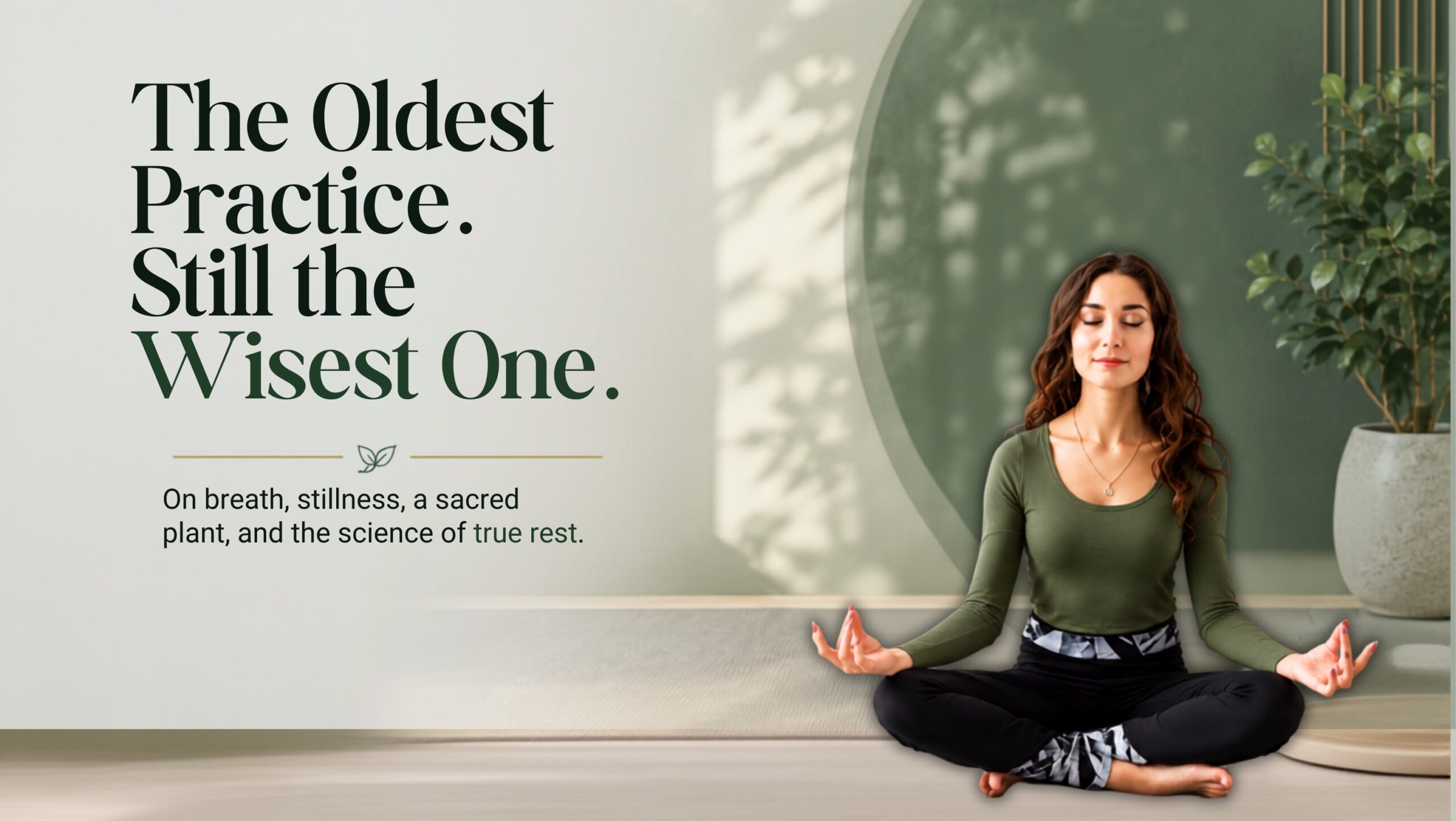
The first instruction in every yoga class is always the same. Breathe.
It sounds too obvious to be useful. But every teacher returns to it, every session without exception, because the breath is the most direct route into the nervous system available without equipment or training. When you slow it deliberately, you are not simply producing a feeling of calm. You are triggering a measurable shift in the autonomic nervous system. Heart rate steadies. Cortisol begins to recede. The prefrontal cortex, edged offline by the accumulated pressure of the day, comes back into full service. These are not metaphors. They are repeatable, documentable physiological events.
What is worth noting is that yoga practitioners mapped this territory through direct observation thousands of years before neuroscience had the tools to confirm it.
The key word, though, is begins. Pranayama initiates the descent. It does not complete it. Yoga opens the door. Something else has to walk through it.
“The soul that moves in the world of the senses and yet keeps the senses in harmony finds rest in quietness.” — The Bhagavad Gita
The Part Nobody Explains Well Enough
Yoga and sleep are not two separate wellness activities that happen to sit near each other in the same category. They are two phases of one biological process. Understanding why changes how you think about both.
During deep sleep, the brain runs its most consequential maintenance cycle. The glymphatic system, which is largely inactive during waking hours, becomes highly active and clears metabolic waste from neural tissue. This is not passive recovery. It is the brain doing work it can only do when consciousness steps aside. Simultaneously, emotional memories are processed and consolidated, stress hormones clear the remainder of the way, and the neural pathways that pranayama began to reinforce are strengthened through the night. The cortisol that a committed yoga session starts to lower, sleep brings down the rest of the way.
When that sleep is shallow or disrupted, everything the practice set in motion is left unfinished. The glymphatic system does not get its window. The neural consolidation does not complete. The cortisol descends partway and stalls. This is why a difficult night undoes so much of what the mat built. It is not a failure of commitment. It is physiology behaving exactly as designed, waiting for a condition that has not arrived.
Ayurveda named this long before modern science arrived at it from the opposite direction. Ancient texts placed Nidra, deep sleep, as one of the three fundamental pillars of life alongside food and celibacy. It was never considered passive. It was understood as an active and irreplaceable form of restoration, as demanding of respect as the practice itself.
“Happiness and misery, nourishment and emaciation, all depend on proper or improper sleep.” — Charaka Samhita
Modern sleep science and the Charaka Samhita reached the same conclusion. They simply took different routes.
Which raises the question the yoga practitioner rarely thinks to ask: if sleep is where the body completes what yoga begins, what supports the quality of that sleep?
The Plant in the Courtyard
For thousands of years, a Tulsi plant has lived in the courtyard of nearly every Indian household. Not as ornament. As a living presence. Each morning, before anything else is done, the plant is tended to, offered water, always attention. The first act of care in the day, performed before the world’s demands begin.
Ancient India understood, through centuries of careful observation, what the plant was doing. Tulsi documented its effects on stress hormones, on neurological function, on inflammatory response. It quieted an agitated mind without dulling its capacities. Under sustained pressure, it supported rather than overrode. The Sanskrit texts classified it as a Rasayana: a substance that works with the body’s own intelligence to restore its natural state of balance. When modern phytoscience eventually directed its instruments toward the plant, it confirmed what Ayurveda had always maintained. The science did not discover Tulsi. It caught up with what India already understood.
The word that matters for any yoga practitioner considering it is adaptogen. Tulsi does not force the nervous system down. It reduces the physiological arousal that keeps the mind circling long after the day has ended. The distinction is important. This is not sedation. Sedation suppresses. An adaptogen converses, in a biological language the body has been fluent in for thousands of years.
This is precisely where Ocitum begins.
The name traces directly to Ocimum, the botanical genus to which Tulsi belongs. That lineage is not decorative. Ocitum addresses one of the most common and least acknowledged challenges in modern wellness: the gap between the end of the day and the onset of genuine, restorative rest. Not tiredness. Rest. The kind the body actually rebuilds itself on.
For anyone who practises yoga sincerely, Ocitum is not a separate intervention requiring a separate rationale. The mat opens the body. The breath settles the mind. In the hours that follow, Ocitum supports the rest that allows everything the practice set in motion to complete itself through the night. K. Patel Phytoextractions has spent twenty-one years in the relationship between plant intelligence and human health. This is that work made tangible.
The plant in the courtyard and the practice on the mat have always belonged to the same tradition. Ocitum makes that connection available.
Three Moments. One Practice.
This is not a routine. It is what the body has always been asking for, expressed in the plainest possible terms.
Morning — Asana and pranayama. Let the body arrive fully before the day makes its demands.
Evening — Slow movement, reduced light, deliberate deceleration. Give the nervous system permission to come down.
Night, with Ocitum — Support the rest your practice has already prepared you for. The sacred plant and the ancient practice have always spoken the same language. Let them finish the conversation together